Gravity Die Casting and Pressure Die Casting: Understanding the Key Differences
In the aluminium casting industry, choosing the right casting process is critical for performance, durability, cost efficiency, and application suitability. Two of the most widely used methods are Gravity Die Casting (GDC) and Pressure Die Casting (PDC). While both processes use metal dies to produce accurate components, their working principles, output characteristics, and ideal applications differ significantly.
Understanding these differences helps OEMs and industrial buyers select the most reliable manufacturing solution for their needs.
What is Gravity Die Casting (GDC)?
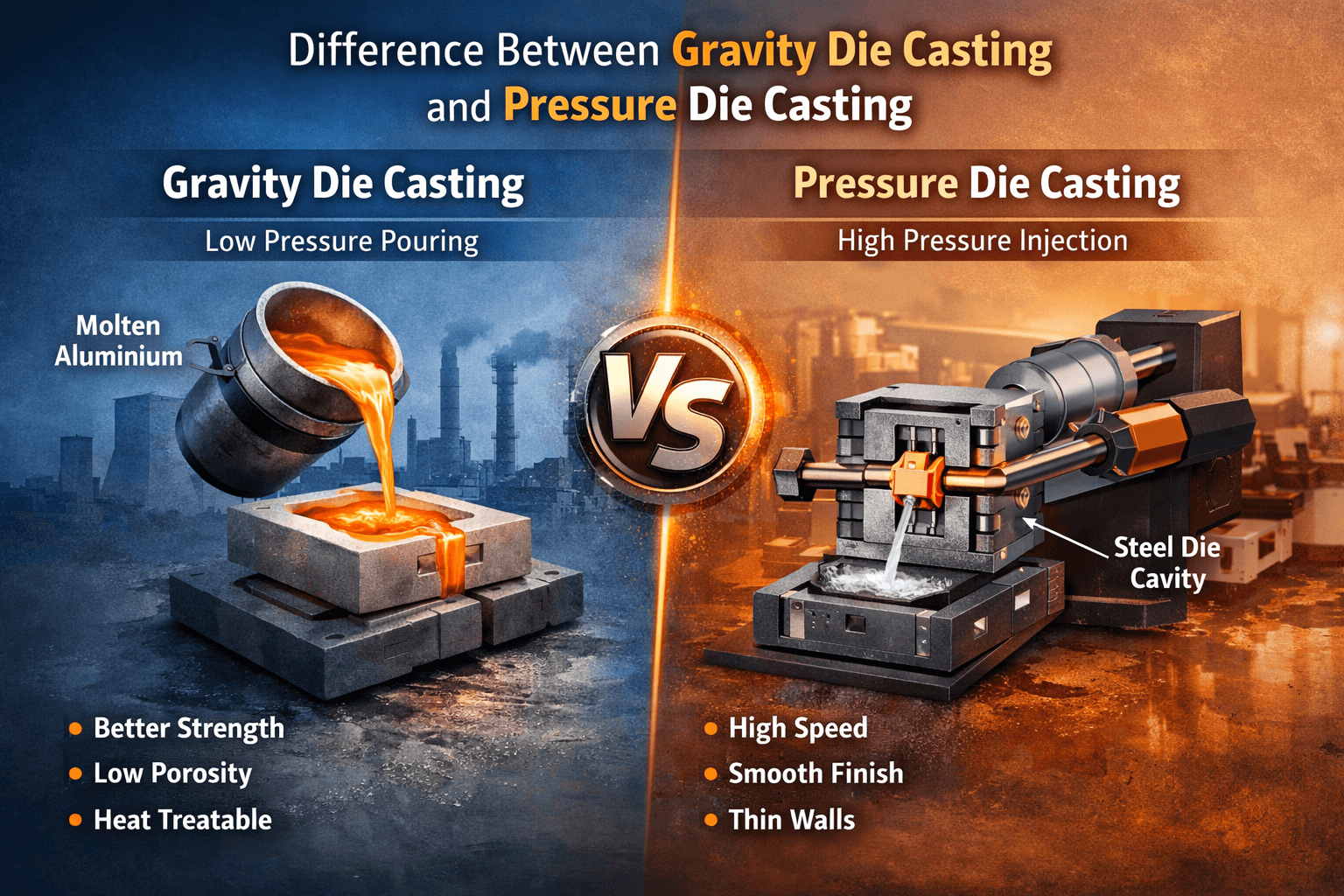
Gravity Die Casting is a process where molten aluminium is poured into a permanent metal mould using gravity alone, without external pressure. The metal flows naturally into the cavity and solidifies under controlled conditions.
Key Characteristics of GDC
Slower, controlled metal filling
Dense and uniform microstructure
Excellent mechanical strength
Low porosity compared to pressure die casting
Suitable for heat treatment
Typical Applications
Power generation components
Electrical and motor housings
Automotive structural parts
Heavy-duty industrial components
GDC is preferred when strength, pressure resistance, and long service life are more important than very high production speed.
What is Pressure Die Casting (PDC)?
Pressure Die Casting involves injecting molten aluminium into a steel die at high pressure using a piston-driven system. This allows rapid filling of complex moulds and enables high-volume production.
Key Characteristics of PDC
Very high production speed
Excellent surface finish
Tight dimensional tolerances
Suitable for thin-walled components
Generally higher porosity
Limited heat treatment capability
Typical Applications
Consumer electronics housings
Automotive non-structural parts
Appliance components
Decorative or lightweight parts
PDC is ideal for large-volume production where surface finish and cycle time are critical.
Key Differences at a Glance
| Aspect | Gravity Die Casting | Pressure Die Casting |
|---|---|---|
| Metal Filling | Gravity-driven | High-pressure injection |
| Porosity | Low | Higher |
| Strength | High | Moderate |
| Heat Treatment | Possible | Limited |
| Wall Thickness | Medium to thick | Thin |
| Tooling Cost | Moderate | High |
| Production Volume | Medium | Very high |
Which Process Should You Choose?
The choice depends entirely on application requirements:
Choose Gravity Die Casting when you need:
Pressure-tight components
Superior mechanical properties
Long-term reliability in critical industries
Heat-treated aluminium parts
Choose Pressure Die Casting when you need:
High-volume production
Excellent surface finish
Thin-walled, lightweight components
Lower per-part cost at scale
For industries like power generation, heavy engineering, and electrical equipment, Gravity Die Casting often provides a more reliable and robust solution.
Why Gravity Die Casting is Preferred for Critical Industries
Gravity Die Casting offers better internal soundness, making it suitable for components that undergo pressure testing, leak testing, and high thermal loads. When combined with CNC/VMC machining, heat treatment, and rigorous quality testing, GDC components deliver consistent performance in demanding environments.
Final Thoughts
Both Gravity Die Casting and Pressure Die Casting play important roles in aluminium manufacturing. Understanding their differences allows engineers and procurement teams to make informed decisions based on performance, durability, and lifecycle expectations.
Selecting the right process is not just about cost—it’s about long-term reliability, safety, and precision in real-world industrial conditions.
Categories
- Precision Aluminium Castings in India
- Why Gescons is Trusted for Aluminium Castings in Critical Industries
- Gescons: Powering Critical Industries with Precision Aluminium Castings
- Gescons' Role in Import Substitution with High-Performance Aluminium Castings
- Aluminium Casting & Machining Insights
- Trusted Aluminium Castings for Critical Industries
- Import Substitution Aluminium Castings
- Aluminium Castings for Power & Energy Sector
- Quality, Testing & Certification in Aluminium Castings
- Advanced Foundry & Machining Capabilities
- Make in India & Import Substitution Manufacturing
- Custom & OEM Aluminium Casting Solutions
Recent Posts

28-05-2026
Why Global OEMs Are Looking to India for High-Quality Aluminium Alloy Castings

21-05-2026
Understanding Gas-Insulated Switchgear (GIS) Components and Their Importance in Modern Power Infrastructure

14-05-2026
CNC Machining and Aluminium Casting: The Perfect Combination for Precision Components
07-05-2026
The Growing Role of Aluminium Cast Components in Power Generation Equipment

01-05-2026
How Aluminium Castings Improve Equipment Reliability in the Oil & Gas Industry

27-03-2026
Sustainable Manufacturing: How Aluminium Casting Supports Eco-Friendly Industrial Growth